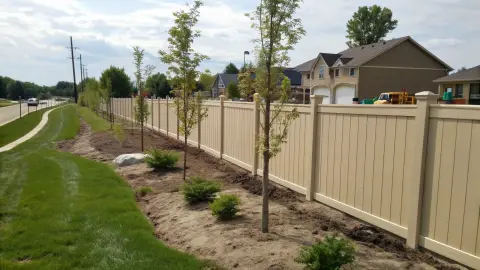
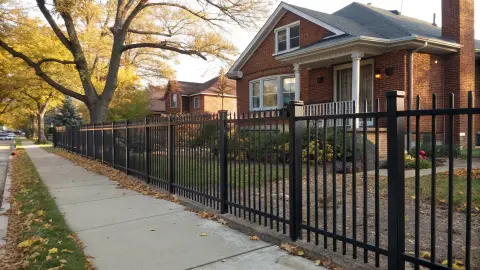
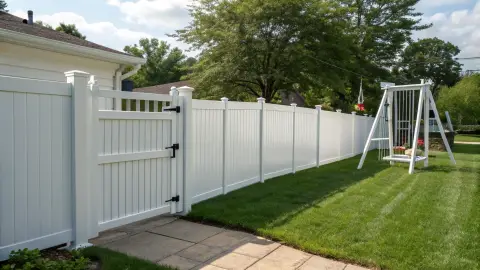
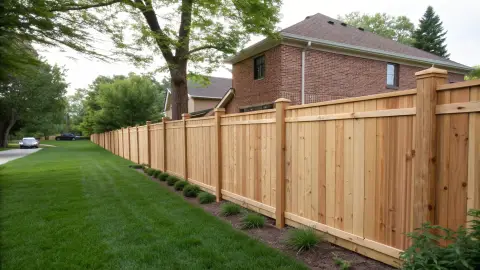
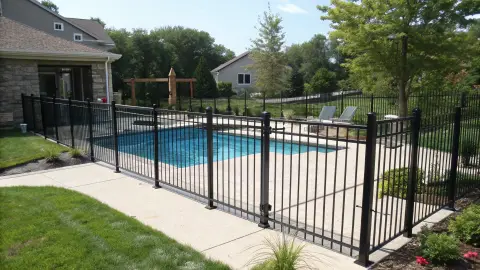
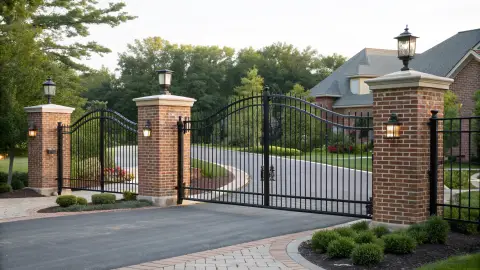
Check this with the city: Evanston's own help article says fences are not allowed in front or street-side yards, while the current zoning code allows some. Ask the city before you plan a front or street-side fence.
Is a permit required?
Evanston requires a certificate of zoning compliance before anyone erects, builds, installs or replaces a fence.
"No person shall erect, construct, install, or replace a fence without first receiving a certificate of zoning compliance."
Source: library.municode.com
The city's fee schedule lists a Fence Permit under Planning and Zoning and says a worksheet is required.
"Fences (worksheet required) First 100 lineal feet of fence $20 Each additional 100 lineal feet $6"
Source: cityofevanston.org
Older fences that predate April 1, 1999 and do not meet current rules may be repaired or replaced if the height does not increase, opacity does not rise more than 30 percent, sight distance is kept, and work finishes within one year.
"All legal nonconforming fences may be repaired or replaced, provided: ... Any replacement of a legal nonconforming fence shall neither increase the fence height beyond the maximum permitted fence height"
Source: library.municode.com
How to apply
Applications go through the city's online Citizen Portal, and only electronic plans are accepted.
"An application for a building permit must be submitted through the Citizen Portal."
Source: cityofevanston.org
What it costs
Evanston charges $20 for the first 100 lineal feet of fence and $6 for each additional 100 lineal feet.
"Fences (worksheet required) First 100 lineal feet of fence $20 Each additional 100 lineal feet $6"
Source: cityofevanston.org
How tall it can be in back and side yards
Residential fences may be up to six feet tall, with an eight-foot limit in a side or rear yard whose lot line borders a nonresidential use.
"Fences accessory to the uses listed in this Subsection (F) shall not exceed six (6) feet in height, except:"
Source: library.municode.com
Side-yard and building-envelope fences must be set back three feet from any front-facing facade of the house unless they connect to a permitted front or street-side fence.
"any fence located within a required interior side yard shall be set back from any front-facing facade of the principal building by three (3) feet"
Source: library.municode.com
Front yards and corner lots
Any fence between the front lot line and three feet behind the front-facing facade of the house is capped at four feet.
"Fences shall not exceed four (4) feet in height when located within the area between a front lot line and three (3) feet behind any front-facing facade of the principal building"
Source: library.municode.com
A fence in the required front yard is allowed only where the front yard is on a street the City Council has designated a type 1 street, with wood, PVC and iron fences limited to 70 percent opacity.
"The required front yard is adjacent to a type 1 street; and ... shall have a maximum fence opacity of seventy percent (70%)"
Source: library.municode.com
A fence in a required street side yard (corner lots) must be two feet off the property line with foundation plantings in that setback, and three feet behind the front-facing facade of the house.
"The required setback is landscaped with foundation plantings"
Source: library.municode.com
Corners and driveways
Where two streets meet, fences must keep a 20-foot by 20-foot sight triangle measured from the curb edges, with a 2.5-foot maximum height inside it; driveways have an 8-foot by 8-foot triangle with a 4-foot maximum height and 70 percent maximum opacity.
"2 Streets 20' × 20' Edge of curbs 2.5' Any"
Source: library.municode.com
Property lines and surveys
Projects with exterior work need a current plat of survey with the permit application; the city does not state a general side or rear lot-line setback in the fence section, only the street-side and facade setbacks.
"Any project that includes exterior work or an addition will also need a copy of a current Plat of Survey."
Source: cityofevanston.org
What is not allowed
Permitted residential fence materials are wood, wood polymer lumber, wrought iron, masonry or stucco, and PVC meeting thickness standards; chain link only where the City Council has listed it along a type 1 street.
"The permitted materials for fences accessory to the uses listed in this Subsection (F) are: (a) Wood; (b) Wood polymer lumber"
Source: library.municode.com
The finished face of a fence must be directed toward neighboring residential property or streets; the unfinished face may face an alley.
"All fences shall have their finished face directed toward residential property or streets, where a residential property is adjacent to the subject property."
Source: library.municode.com
Other rules
A fence at an Evanston landmark or in a historic district needs a certificate of appropriateness first.
"No person shall erect, construct, install, or replace a fence accessory to an Evanston landmark or a use located within a designated historic district without first receiving a certificate of appropriateness."
Source: library.municode.com
Before anyone digs
Illinois law requires a call to JULIE, the state's one-call system, before digging post holes. Call 811 or (800) 892-0123, or file online, at least 3 days before work starts. The call is free, and the locate is good for 25 days. On a hired job, the company doing the digging makes the call. More on Illinois fence rules
We are not the City of Evanston. Rules change, and some neighborhoods and HOAs have their own. Confirm with the city before you build. Spotted something out of date? Tell us.